Our Story
Who
We Are
Long before there was a Krewe of Pyros, there was a sound. It came from Congo Square — the birthplace of American music, and the root from which our whole story grows.
Congo Square is where enslaved Africans were permitted, on Sundays, to gather, drum, and dance — the only place in antebellum America where African rhythm, language, and spirit were allowed to survive in the open. That square is widely regarded as the birthplace of American music. It is the seed of jazz, gospel, blues, rhythm and blues, bounce, and eventually hip hop.
New Orleans did not simply produce music. New Orleans produced a way of turning grief into rhythm, struggle into procession, and survival into celebration. That spirit moved through Mahalia Jackson's voice and Louis Armstrong's horn. It marched through the brass bands that turn funerals into homegoings and second lines into rolling block parties. Southern hip hop, bounce, brass, jazz — these are chapters of the same diaspora story, written in Louisiana and read by the world.
And Louisiana itself has never been one thing. From Shreveport to New Iberia, from Lake Caddo to Lake Pontchartrain, from the bayous of Central Louisiana to the barrier islands of the coast, the state is a melting pot — French, Spanish, African, Caribbean, Creole, Cajun, Indigenous — folded into one another over three centuries. The Krewe of Pyros carries that full diversity, not just one slice of it.
How We Got to Washington, D.C.
Not everyone who calls the DMV home by way of Louisiana chose to leave. On August 29, 2005, Hurricane Katrina made landfall on the Gulf Coast. The levee failures that followed flooded roughly 80 percent of New Orleans and claimed an estimated 1,400 to 1,800 lives — among the deadliest disasters in American history.
More than a million people were displaced. The Lower Ninth Ward, Gentilly, New Orleans East — emptied within days, residents scattered to Houston, Atlanta, Memphis, and the Washington, D.C. region, often with only what they could carry. For many Louisiana natives who landed in the DMV, the move was not the pursuit of opportunity often described in the telling. It was survival. It was a forced migration carrying generations of culture into a region that, for all its diversity, did not know what it was receiving.
From Survival to Celebration
In the years after the storm, transplanted Louisianans across the DMV began finding each other — at church, at work, at cookouts, at Saints Watch Parties on Sundays. What started as informal gatherings of people who missed home became something more intentional: a shared determination to keep Louisiana culture alive for the next generation growing up outside it, and to introduce that culture, on its own terms, to the Nation's Capital.
That determination is what gave rise to the Krewe of Pyros in 2016.
The History of KOP
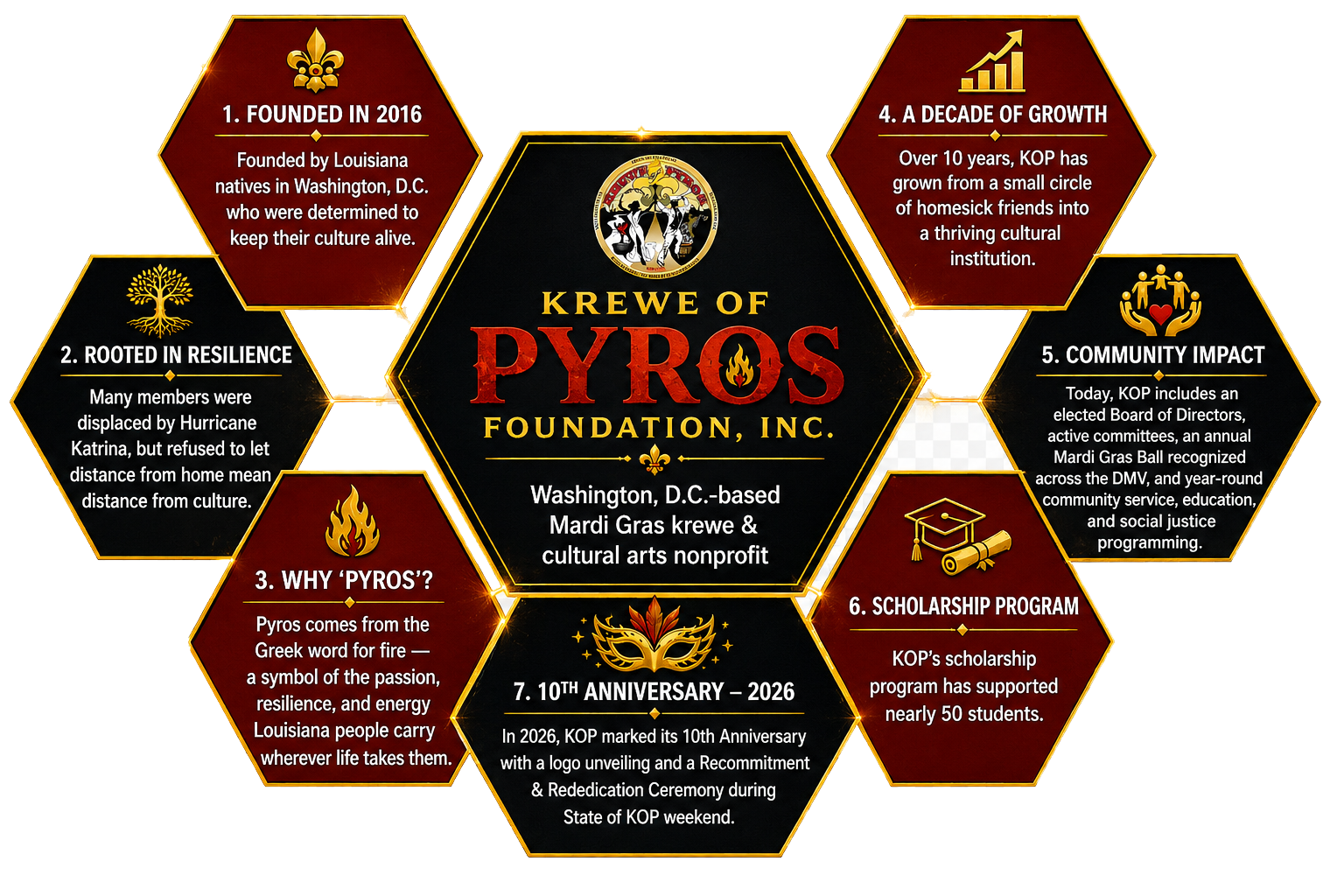
The Krewe of Pyros Foundation, Inc. is a Washington, D.C.–based Mardi Gras krewe and cultural arts nonprofit, founded in 2016 by Louisiana natives — many displaced by Hurricane Katrina — who refused to let distance from home mean distance from culture. The name Pyros comes from the Greek word for fire, chosen because "fire" and "fiyah" describe something every member recognizes in themselves: the passion, resilience, and energy of Louisiana people, no matter where life has taken them.
Over ten years, KOP has grown from a small circle of homesick friends into a full cultural institution — with an elected Board of Directors, active committees, an annual Mardi Gras Ball recognized across the DMV, a scholarship program that has supported nearly 50 students, and a calendar of community service, education, and social justice programming. In 2026, KOP marked its 10th Anniversary with a logo unveiling and a Recommitment and Rededication Ceremony during its State of KOP weekend.
Our Vision
A nationally recognized cultural ambassador
To become a platform that carries the story of our Mardi Gras experience, from New Orleans and across Louisiana, positioning our culture not as entertainment for others, but as a legacy worth protecting, teaching, and celebrating on our own terms.
Our Mission
To provide representation of Louisiana cultural arts through unity, charity, and celebration. We exist at the intersection of culture, education, and community — a cultural institution in formation, dedicated to illuminating pathways to empowerment for our members and the communities we serve.
Illuminating the Path to Empowerment
What Is a Mardi Gras Krewe?
If you didn't grow up in Louisiana, the language of Mardi Gras can take some explaining — and we love sharing it. A krewe is a private social organization that puts on Mardi Gras festivities: parades, balls, and community events. The tradition dates back to the 1850s in New Orleans, when it was first used (borrowed from an old spelling of "crew") to describe a club organized around Carnival. Today, there are hundreds of krewes across Louisiana, each with its own traditions, colors, throws, and personality.
What Is a Captain?
Every krewe has a Captain — traditionally the founder and the krewe's ultimate authority on its traditions, identity, and direction. The Captain is often described as the keeper of the krewe's soul: the person who carries its founding vision forward, sets the tone for its culture, and serves, often anonymously to the public, as the figure who makes the magic happen behind the scenes.